Pages

Friday, April 5, 2013

How to Integrate Social Media into CRM for Better Customer Relation.


“To start integrating social media into existing CRM, we are seeing that initially:You have to understand your customers’ conversation pattern. Do research to find out if they’re using social media and which social media.
Define your goals and objectives based on your needs and requirements – Based on the research, and in line with customer strategy, choose which social media channels are going to be implemented and have significant impact. Do you need to be on Facebook? Or is Twitter sufficient?
Does this require integration with an existing contact center?
Finally, you have to establish a project team who will be responsible for thorough implementation of this initiative.
Create a pilot case for the social media integration, define the new business process, assign the PICs of each task and have the existing CRM system ready for social media integration.”
-- Aina Neva Fiati, Founder of www.ThinkAboutCRM.com

Social Media into CRM


“There are a lot of recommendations and advice available to those seeking to leverage social media as part of a CRM strategy. I tend to look that these questions very pragmatically. We are past the point of talking conceptually. I think folks are looking for practical applications that can be implemented and that will deliver measurable value.
Here are three thoughts that hopefully achieve that end. In the simplest terms,
Agree on what social media is. Practically, social media is a communication channel. Use it as such.
Modify your CRM business processes to incorporate customers’ social activity and identities into your customer master. Its flying blind to be tweeting with @The Dude, not knowing if he’s one of your most valuable customers or not.
Collect and analyze only that social data that demonstrates how to improve your customer experience design. If it doesn’t do that, if it doesn’t move the needle on your customer experience metrics, don’t waste your time.
Now, that is certainly not an exhaustive list of things to think about with respect to social CRM.
But, a laundry list of a thousand items starts with number one.”
-- Barry Dalton

Read More... Résuméabuiyad

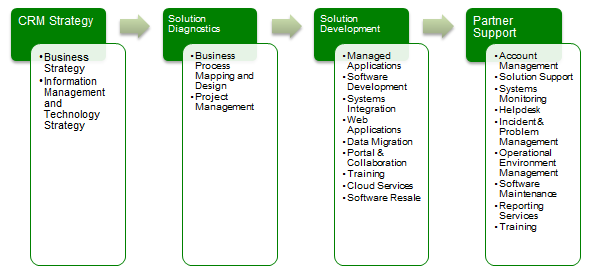
Why you need to Selecting a CRM Implementation Partner ?


As your company embarks on a CRM initiative, the software selection is only one facet of a successful project. As part of this process, you may consider implementing your CRM system with internal resources. Some software and on-demand vendors’ position their products as easy to implement and easy to use, suggesting that your organization try to do it itself. As outlined in this article, there are many benefits in selecting a CRM implementation partner.
Even in providing a very simple CRM system to your organization, a variety of steps need to take place including project management, requirements gathering, planning, configuration, pilot-program, rollout, training, and support. An experienced CRM implementation partner has the resources to address each of these areas, providing a company significant benefits that increase the chances of a successful system.

CRM Implementation Partner


Planning


In planning a CRM system, you have a variety of people involved in the process including sales, marketing, and customer service at various levels including staff, management, and executives. This can be a very complicated and difficult process, dealing with potential political issues and personalities. One of the services that a CRM implementation partner will provide is a resource that can act as a facilitator and buffer during this process. They can use their experience to guide the organization in the appropriate direction.
As noted above, there are various steps that need to take place in a successful CRM rollout.
A CRM Implementation Firm has the experience to properly plan the various steps in this process.

Installation, Configuration, and Customization


Once a company has determined what they need from a CRM system, those requirements need to be translated and configured within the CRM product. Although a company may have technical resources within their organization, there is still a learning curve involved with a new product. In addition, there can be more than one way to configure a CRM system. An experienced CRM implementation firm can provide you with the most efficient configuration that will provide the optimum ease of use.

Better Access to Technical Support


Although your CRM system will provide the end-user with technical support, your CRM implementation partner has access to a higher level and faster response technical support service provided by the vendor. In addition, they may have more leverage in getting a technical issue resolved more quickly than through end-user channels.

CRM Implementation Partner 2

Business Process Experience


A CRM implementation partner has gathered significant business process experience from their previous engagements. You need to have a certain skill set to evaluate an organization’s business processes, make recommendations for improvement, and apply those processes to a CRM software system. Without this particular experience, it is very difficult and time consuming for a company to do this with internal resources.

Depth of Skill Set


Implementing a CRM system takes a variety of skill sets including configuration experience for that particular product, programming and development experience, database knowledge, project management capabilities, training skills (both technical and presentation), and report writing experience. Very few companies have all these skills available and even if they do, they must be pulled away from their regular jobs.

Resource Constraints


As mentioned above, your organization maybe large enough to have the various skills needed to implement a CRM system. But people have their regular jobs and responsibilities on a day-to-day basis. Reassigning them to a CRM project can cause a variety of issues. A CRM implementation firm provides you with the experienced resources you need without having to tap and strain your own staff.
Although you may think that using an outside firm is more expensive, that is not the case.
When you calculate the cost of your own staff and their overhead, the additional time it takes to learn the CRM product, and the cost of their daily responsibilities not being completed, you will find that using an outside firm is not more expensive.
A CRM implementation firm can provide you with the right resources at the right time that will allow a company to complete a CRM rollout on a timely basis.

Read More... Résuméabuiyad

Thursday, April 4, 2013

Hosted CRM vs On-Premise CRM based on Company Size


Hosted CRM vs On-Premise CRM


Under 10

Hosted CRM

Good solution, more affordable, easy to install and maintain, can grow with company.

On-Premise CRM

Could be expensive and difficult to install and maintain.

11 – 50

Hosted CRM

Good choice, predictable scalability up and down, predictable cost, easy to implement and operate.

On-Premise CRM

Price could be an issue. Integration into other parts of business operations could be a plus.


51 – 100

Hosted CRM

Price could become an issue. Predictability from a cost standpoint an advantage. Performance could be a problem.

On-Premise CRM

Price could be an issue. Integration and customization a plus. Performance could be a plus.

101 – 300

Hosted CRM

Price likely to be an issue. Performance might be an issue. Predictability and ease of operation still a plus.

On-Premise CRM

Price could be a plus. Integration and customization with existing systems a plus. Performance a plus. Could be issues with operation.

301 +

Hosted CRM

Price an issue. Performance an issue.

On-Premise CRM

Integration and customization clear benefits. Performance a clear benefit. Price could be a benefit.
Read More... Résuméabuiyad

Hosted CRM vs On-Premise CRM vs Hybrid CRM


Hosted CRM vs On-Premise CRM vs Hybrid CRM


Hosted CRM


Description

Provided as a service and equipment hosted by provider

Advantages

Predictable cost, easy to implement, easy to operate.

Disadvantages

Customizing more difficult. Possible performance issues.

Example Solution Providers

Salesforce.com, Omnivue, Agile Wave, Oracle, NetSuite


On-Premise CRM


Description

Complete CRM which runs on equipment within the business.

Advantages

Customizable, flexible, can be higher performance.

Disadvantages

Cost can be higher. More difficult to implement. Can costly to operate.

Example Solution Providers

SugarCRM, Microsoft, Onyx, Siebel (Oracle), SAP, Pivotal

Hybrid CRM


Description

CRM solutions that try to blend the advantages of hosted and on-premise.

Advantages

Tries to offer the advantages of both hosted and on-premise combined.

Disadvantages

Can be hard to implement all features.

Example Solution Providers

Most on-premise offer forms of hybrid solutions. Some hosted providers with offerings.
Read More... Résuméabuiyad

Wednesday, April 3, 2013

Hosted CRM Solutions


Hosted or on-demand (or even SaaS) CRM refers to a solution where much or all of the functionality of a CRM solution is outsourced to a solution provider that is not located on the premises of the organization. Usually this simplifies implementation since additional hardware and even software is not required and the pricing structures are highly predictable since providers charge on a monthly basis. In addition, it frees the company to focus on its core business and on making effective use of the solution.
Third party research has shown that typically over 80 percent of companies that use a hosted CRM solution achieve a positive ROI. It is a particularly effective solution for smaller organizations where the costs of implementing on premise solutions can be too high a barrier to entry. However, hosted solutions do have drawbacks. The primary drawbacks are flexibility and customization. Hosted providers cannot truly integrate their solutions into existing operations, whereas on-premise CRM solutions can be tailored to the particular needs of an organization. Furthermore, on-premise solutions are easier to integrate into a company’s existing business processes and applications.


Hosted CRM Solutions


For small- to medium-size businesses, however, the price is right when it comes to hosted CRM tools. By paying per user per month, a company can gain access to a sophisticated application in a mere 30 days without having to burden its IT department or cut off its cash flow. And of particularly good news to growing companies is the fact that today’s on-demand CRM solutions are highly scalable and easy to upgrade.

Advantages 

Hosted CRM advantages

The advantages to a hosted CRM solution for a business are compelling. A predictable pricing structure makes it easy to calculate ROI and predict cost. Rapid deployment can have your team up and running in days if needed. Easy and automatic upgrades can take place without your IT staff's intervention. Flexible options and a wide range of add-on tools and capabilities are also available because of hosted CRM's success.
Other potential advantages can include lower operating costs, greater safety because of automatic off-site backup and a lower overall IT cost. However, these advantages can be matched in many cases by a good on premise solution.

Cost 

Hosted CRM cost

Hosted CRM solutions are usually priced in two parts. The first is a setup or overall fee that can be one time or monthly and can range from free to as high as $200 per month or several thousand dollars one-off. Much of that cost depends on the size of the installation. Then there is typically a per seat per month fee that can be as little as $15 per month to as much as $100 per month depending on the solution and options. For a small business of about ten to twenty seats, a typical cost would be a $200 setup and $40 per seat per month.

Read More... Résuméabuiyad

On Premise CRM Solutions


On-premise CRM solutions involve either software or hardware and software in combination that are purchased outright and installed at the organization's location. Usually they are a software solution that runs on the organization's servers and that can be integrated with existing software to make a more customized solution.

The biggest single advantage for an on-premise CRM solution is that you own it. You own the software, you own the data, you control everything and if it is what you need then theoretically there is nothing else to purchase ever again. But, like with all software, there are licensing issues – and the most important ones are likely to do with support and upgrades. If you will need support, then you can expect to pay for it after an initial period – and it is likely to be costly.
But there are other reasons to go with an on premise solution. One is performance. With a hosted solution you are limited in control over implementation and are limited to the performance you provider can offer. That may not matter for some but if you want to be able to tune your performance and to offer things like virtualization where you might be able to scale dynamically and have much greater performance at certain times of day, for example, then an on premise solution is likely to work better.

On Premise CRM Solutions


Another reason could be regulatory – some organizations require complete and total control of data by federal or industry regulation. The most obvious example is the healthcare industry where patient data is strongly protected by HIPPA. While there are a few hosted solutions that can provide more expensive solutions to control data with proper audit trails, they are less certain, less flexible and could cost more.
Finally, on premise solutions offer the ability to integrate and customize more than even the most flexible hosted solution. If your CRM applications require extreme integration and customization, then an on premise solution may be your only choice.

Advantages 


On Premise CRM advantages


Many of the advantages of an on premise solution have been covered already. Since it is software that you bring in house and run on your own servers, you have full control. You can choose the level of installation, the amount of integration and customization and you control the software itself and the data on your own servers. This means that you can do more customization and integration, making for a potentially more effective solution. If you already use software from a suite provider of on premise solutions then the integration may already be done and be very tightly coupled.
However, you will have higher initial costs for purchase of software and hardware, higher installation costs and possibly higher maintenance costs. You may be slower to receive upgrades if you choose not to upgrade you core software as often (at an additional cost). And you are tied more tightly in to the solution you choose so your decision must be a good one.

Cost 

On Premise CRM cost

The initial cost of an on premise solution depends on the needed hardware and software. While there are technically 'free' open source solutions, they still require adequate hardware and integration so they are not truly free. A typical initial cost will be at least a couple of thousand dollars and could go as high as tens of thousands of dollars. On the other hand there are no additional costs later apart from maintenance – which is not inconsiderable but could work out as a cost benefit over time versus a hosted solution for a large enterprise.

Read More... Résuméabuiyad

Have a look on CRM Market and History


CRM has its roots in customer and contact management software. In the 1980's, tools like Goldmine and ACT provided good resources for managing customer databases and customer contacts so that companies could call or email more effectively. But these tools were mostly used simply to gather existing customer information and incoming customer contacts and then treat the whole customer list as one.
In the 1990s, enterprises began to need to treat their customers in a more sophisticated manner and treat customer groups differently. Early CRM pioneers started to treat enterprise management software categories as serious business. SAP, PeopleSoft and Oracle had broad solutions that included CRM solutions as part of a package and Siebel started with CRM and then added to it. Interestingly Oracle has consolidated two of these companies into itself, making it one of the market leaders. SAP remains a strong overall solution but with CRM as one module within a larger offering, which is where Oracle has taken its consolidated offerings.
In addition there are many smaller companies specializing in CRM. In fact the original contact manager companies like Goldmine and ACT expanded their offerings to become true CRM. Goldmine is now part of the Front range suite and ACT is part of the Sage range of offerings.

Infographic: Lessons from the History of CRM

Lessons from the History of CRM


The biggest change in CRM, however, came about with the advent of SaaS in the 2000's. The biggest trend is the rise of SaaS or hosted solutions and the leading name there is Salesforce.com. Salesforce.com dominates the hosted CRM market and has taken a lead in making a hosted solution acceptable even to the largest enterprises. The second development is the rise of open source solutions that start with free offerings and range on up to paid and fully supported enterprise class solutions. The leader in this area is SugarCRM. Microsoft is also a player in the hosted and on premise arenas with its Microsoft Dynamics CRM solution.
This brings us to the present day where there are a wide range of CRM offerings that cover a gamut from small to large hosted solutions, on premise offerings and even free CRM solutions. For anyone wishing to purchase a CRM solution there is absolutely a good solution available, but sorting out the details and making the right choice can be very difficult.

Read More... Résuméabuiyad